Showing posts with label made by Elmtree. Show all posts

Jul 3, 2019

Experimental Eco-dyeing on Paper.


At the moment I am enamoured with paper, and am slowly tidying several piles of vintage books, papers and card. Another re-purposed book is in the making with a woodland theme, and I am making a lot of my own resources instead of buying new purpose printed, and generic (which makes it very boring for me) craft paper from the shop. I had a lovely bouquet from my daughter, which was definitely past its' beauty, and the technique of eco-dyeing was studied on-line.

Resulting eco-dyed pages, after drying and pressing.
Natural dyeing is something I have done before, with wool yarn, to get an overall colour, so I know a little about mordanting and different plants. I was expecting subtle colours, and hoped for stronger imprints. I was also doubtful about the papers holding together.

Ingredients; plant materials, papers, alum as mordant,
 and a large pan, which will only be used for this.
I bought an electric frying pan with lid secondhand for $15, as it can contain the papers lying flat, and it has a thermostat which can be set to 80'C, as keeping it all simmering, is more dye productive than boiling. Boiling can destroy the dye molecules.

Dried larkspur, blue hyacinth, daisies, gerbera, bay leaves,
ferns, adding red onion leaves, lichens, etc.

Fresh winter pick of ferns, climbing ivy leaves and berries,
eucalyptus, oak, and  old autumn leaves.
I went around our property and gathered some more plant material. Hopefully those ivy berries would give some colour. Now to prepare the mordant and papers.

2 tablespoons of alum in a throw away container,
although alum is fairly harmless.

Dissolve the alum in warm water.
I decided to use filtered water, as we have chlorine in our water these days. Chlorine has a bleaching effect of course, and I did not need a chemical reaction like that at all...

Wetting the papers in the alum water.
To prepare the stack of paper, both thick, transparent, new and vintage, I simply submerged them in the alum water and stacked them on the plastic covered table.

All the leaves sandwiched in the wet papers.
I took off a lot of hard woody stems, and arranged the leaves, flowers and berries in the wet papers.
Some paper had already given up the ghost, mainly lined school writing paper. It just fell apart.

I tied up the stack with a large wide ribbon.
At first I wanted to tie up the big sandwich with wire, but was afraid it would just rip the paper. A friend had just given me meters of wide satin ribbon. That held it together gentler, and still tight enough for the plant material not to shift place.

eucalyptus leaf and gumnut, avocado skin, and copper tube offcuts.
Added to the dye bath to provide overall colour, I added gum leaves and nut (goldens), avocado skin (soft pinks) and copper tube offcuts, which can bring out greens and blues from the dye plants.
You can instead add rusty iron, but that can bring out more yellow and browns, and darken colours.
For that reason I don't use an aluminium pan, as that will only produce 1 result. this pan has a teflon coating, elliminating any reactions. Stainless steel is also neutral. An enamelled pan should not have cracks or chips in the enamel, this exposes the iron underneath. Unless you want that.

Submerging the paper sandwich with a heat proof weight.
Time to cook. The papers were weighted down under the pans' lid, and I brought the allumed and added filtered water nearly to the boil, then set the thermostat to 85/90 'Celcius.
And left it to simmer, with the kitchen windows open, for an hour.
(Please be aware that some plants can produce poisonous fumes, such as oleander. Don't use it. Please check.) 
Simmer gently for an hour.

Take out the hot package with care.

Drain and cool.
I let the bundle drain and cool down. I contemplated letting the papers dry overnight, flat with the plant material on it. But plants were already falling off, and I was going away for a few days. Things would have gone moldy instead.
So I unpacked everything, and was pleasantly surprised.
All the papers drying in the kitchen.

Crinkles and folds.
Beautiful green leaf imprints.
Some of the colours are subtle, and there are lovely organic plant imprints. A number of cheap printing papers were ripped, or got holes in it. The thick vintage kids book pages worked very well, so did photo album pages with the in between tissue papers. Old music sheets and thicker printing papers did well too. After they all dried, I pressed the pages with an iron for a smoother finish.
Another successful experiment, for the girl that failed chemistry!
Blues from the climbing ivy berries and pink from bougainvillaea.


Apr 2, 2019

How to Alter an Old Book into a New Journal.

Altered Book Journal.
If you feel the need to journal your days, or are trying to keep track of things, why not make it really personal and create your own Notebook.
(If you have a problem with "hurting" books, please remember there isn't actually a "Book Police"..)
So here is my picture-rich tutorial on how to make your own Journal out of an old book.

STEP 1;   Get an old book from a second-hand book shop, flea market, or check with local library throw outs or relatives' bookshelves.
 Don't get a book that has hundreds of pages, it is just daunting to work in.
Make sure it is a hard-cover book, and that the pages have been sewn in, NOT glued in. After you are finished with it, and have added glues and paints and collage, you don't want your pages to fall out of the book because the glue holding the book together has weakened.
You can check if the pages are sewn in, by checking at the top of the spine, to see if the papers have been bend double. There should be a visible loop of papers. When you open the book in the middle of one of those loops (which is a stack of papers called a "signature"), you should find a thread down the middle of the pages.
Finding and reducing volume of signatures.
STEP 2;    In my case I found a (rather tedious) girls' book about an english boarding school. It had a faded blue linen cover. Each signature had 5 pieces of doubled paper. I reduced that throughout the book by carefully ripping out 1 full page, taking care not to break the thread. Because you will be adding extra paper, glue and paint, the book still needs to be able to close.
Each signature now had a number of pages divisable by 2, because now you are going to glue 2 pages together. This way the paper will be thicker and can handle all the stuff you are going to do to it. You can use either a good glue-stick for this, or tacky craft glue. Don't use normal p.v.a. or white craft glue, as it is too wet, and it will seriously buckle your pages. And will take ages to dry.
 I used a glue-stick for this book. Let dry by standing the book up with the pages open.
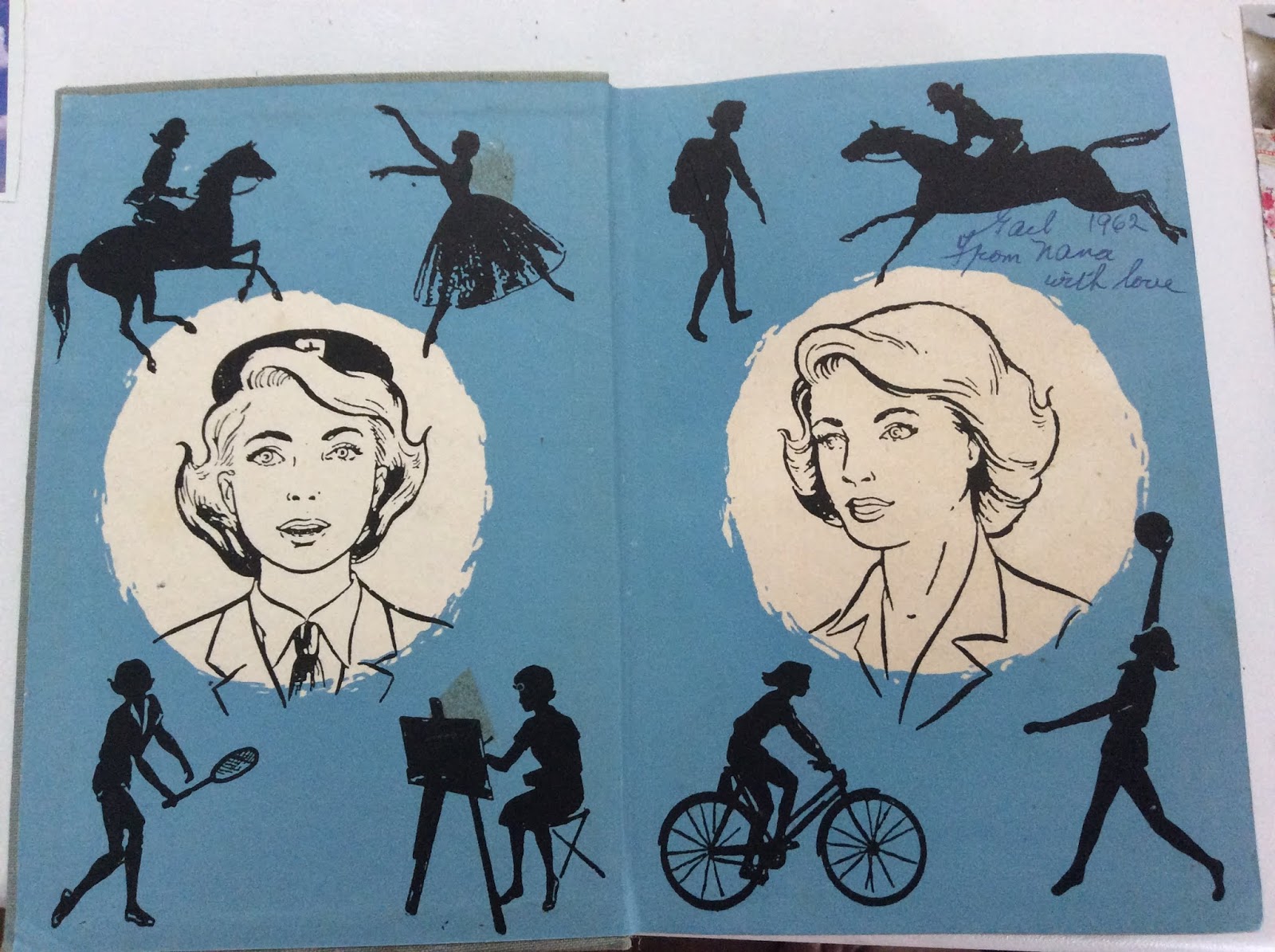
The end papers were really cute, and I left the inscription from 1962.

Old magazine, coffee and rip rip rip!
STEP 3;   Decorating your Journal-to-be. This is a really relaxing bit, where you get an old magazine, a hot cuppa, and cut or rip out pictures and quotes that you like. I used just 1 Country Living UK magazine for this whole journal, it was so chock-full of goodness. But you might like a fashion mag, or nature, or travelling; whatever takes your fancy.
Make sure the pictures are not too big, as you want to leave some space for actual journaling...

Some pictures are cut, some ripped for soft lines.
STEP 4;    Glue your pictures into the book, using a gluestick. Smooth any air bubbles out with your fingers, or an old plastic bankcard. Keep them to the edges of the book pages.

Stand the book upright with the pages fanned out to dry.
I found that I was colour coordinating images, or theming things together on the same page.

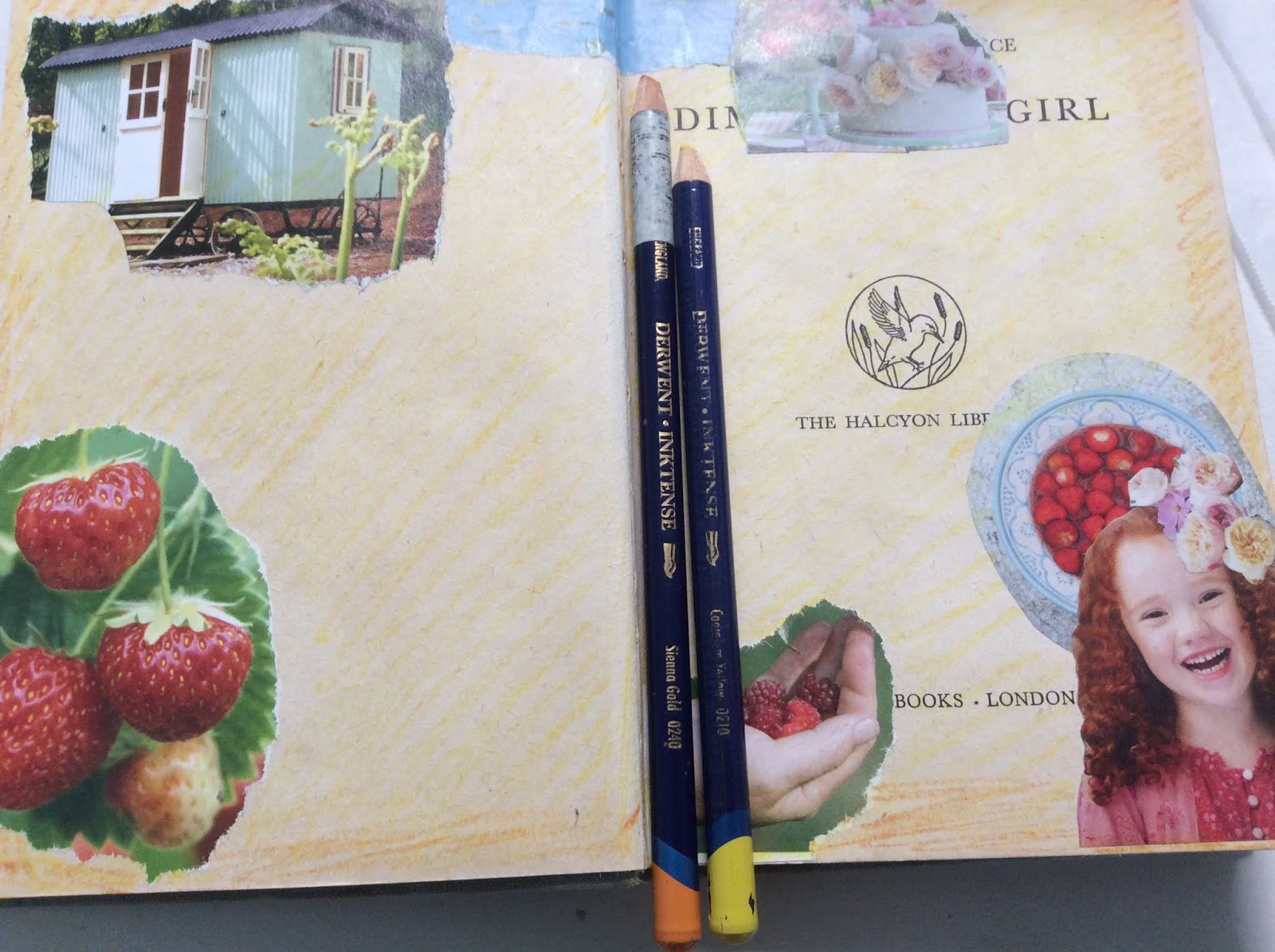
Using water activated colouring pencils, Derwent Inktense.
STEP 5;    Adding colour to your pages. I used my Derwent Inktense colouring pencils, but you can use other aqua pencils. I just scribbled different colours all over the pages, choosing to coordinate with the colours in my pictures.
 ( It's o.k. Really. No one is going to come and arrest you, for defacing this old book. You are just rescuing it from landfill, to live a new life...)
White Gesso.
STEP 6;    Now you can brush white Gesso over the top of all your colour scribbling, and partly over the pictures. Gesso is usually used to prepare a surface for painting, as it is a bit chalky to the touch and lets paint and glue adhere well. We are using it in the journal to obscure the printed words, and at the same time activate the coloured pencil pigments. The colours will blend into the Gesso, giving a soft colour, but you will still be able to faintly see the print and edges of the pictures underneath. This gives a lovely layered depth effect to your pages.
Obscuring text with tinted gesso.

Using the tinted gesso to soften and blend pictures into the page.

Drying in the sun.
Gesso a couple of pages at the same time, then dry well, leaving the pages spread open.

Drawing in cubbyholes for the days, using a cardboard rectangle.

STEP 7; Rooming in your Journal. Depending on how you want to journal, you can now create spaces on the pages for note keeping. My new Journal had 29 full spreads, giving me 2 spreads for each month, with some spare pages. I worked out how many rectangles I could fit across a page, without having to write too small, and then made a little rectangle from the magazine cover that I had ripped up. I used it as a template to draw around with a black pencil. These measurements all depend on how large or small your old book is.
I used a black pencil, because Gesso can be a pain to write on with a Sharpie felt pen.
For that reason I also suggest a gel pen, or ballpoint pen for writing.


I left some space at the end of each month to record things like exercise session totals, etc.
And a page for books I have read, at the end of my new Journal.

Adding vintage fabrics and notions for the cover.
STEP 8;    Decorating the cover of the book. I used some old embroideries, a piece out of a stained, but cheerful tablecloth, vintage cards of hooks and eyes, and a crocheted flower. I used pinking shears to cut out the fabric, to minimise un-ravelling, and carefully cut around the embroidery, without cutting the embroidery threads. Using a generous amount of tacky craft glue on the back of the fabrics I stuck them down. Make sure the fabric goes into the grooves of the book, to give space in the fabric when opening and closing the book. The fabric also covered up the original title of the book.

A bookmark with tag.
STEP 9;    I wanted a bookmark, and found a suitable length of ribbon. (Actually, this ribbon was inside the shoulder seams of one of my shirts, for hanging purposes, but always flipped out of my shirt while wearing it. So I cut it off...) Adding tacky craft glue to one end and using a thin knitting needle I pushed it into and against the spine of the book, and held it there until it started to stick.
A fancy card tag from a new garment was re-used to make my collaged bookmark. I also added some beads to the ribbon.
My Journal in use.
STEP 10;    Start using your Journal!  I use mine to track sleep patterns, exercise, mental health, and to prompt myself into creativity. It is your Journal, so do what you like in it.

 I just had to create one of my collage critters in it, with the left over magazine pictures. Fun!

A Sweet Collage Critter of mine.


Jul 5, 2016

Ahrr, me Hearties, where's me treasures...!

Chocolate-box full of auction treasure.
So I couldn't felt last year. Not that I felt all the time, mind, but when you get told you can't do something, the itch gets worse. 
While tidying (yes really..) I opened the bottom drawer, which was empty many years ago and thus had become a perfect place to put interesting necklaces and beads into, which had come home because they looked useful. I decided to tip the drawer upside down on the empty table, just to see what had gathered there. And gave myself a fright.
Quite a bit of jewellery. 
O.k. 
So I started cleaning, dismantling and sorting everything. Colours by colours, metals by metals, glass, pearls, semi-precious stones, brooches, I even kept the findings and closures.

Some odd-ball bits as well.
A  course at the local Arts Centre presented itself, how to repair and remake old jewellery.
 Very timely the Universe provided, yet again.
I had a great time and learned a lot.
I won a couple of Auctions from down the hill, just to add really odd and old stuff to the mix.
I can't wait to somehow use those fountain-pen nibs, or that sweet little spoon.

Another auction lot...
And no-one else put a bid on that box with tatty looking rags, bits of fur and an old tin of baking powder, but I had already spotted in that jumble black silk dress pieces; never put together, water taffeta, handmade tatting and very old lace pieces, an old leather wallet with silver corners, sequins and gold lace, braiding and ribbons, and an old foxy stole. Most from the first half of the 1900's judging by the shape of the dress pieces and lace.
A veritable feast for a textile lover.
Now, how to incorporate fur....

It looked like a jumble of scraps, however...
Then I started playing. And combining, and trying stuff out.
Taking away and adding.

Playing.
Treasure for myself.
This one is for myself.  
Sterling silver, real pearls, moonstone, rose quartz, antique lace, a belt buckle, a tiny key, sparkly bracelet links, vintage porcelain forget-me-nots and a Madonna medallion to represent the Goddess in all her forms.
I love wearing it.

Peony Roses in an old coffeepot.
Oh I wish it were Spring already. But we have only just gone past the shortest day.... 
Luckily photos cheer me up too.


Jun 6, 2016

Feather-weight Wool.

Felted aqua-blue feather wrap.

Wow, I haven't posted since March last year! That's no good, and I've sure been busy, so I have plenty to tell you. Probably too much for this time so I'll give it to you in small bites.

First up is the gorgeous wrap I finished this week, I am very happy with it indeed.
It is made with 2 layers of fine merino wool and layers of delicate silk tissue fabric, with embroidered feathers.
Finishing the felting process.

Nuno-felting details with silk tissue.
It took 2 trestle tables to lay out the wool, and a day to finish laying it. It was felted really well, and I adore the nuno wrinkled effect of the fabric fused into the wool. But I left an edge loose to provide movement with the slightest breath of air.

Hollow bubbles

I also felted air-bubbles into one of the ends of the wrap, again to play with the idea of lightness. It is a technique I have been practising since I went to the Wellington Area Felting retreat in February, where I tried it for the first time. It was wonderful to be able to go there again, now that my right shoulder is so much better. Still a few niggles at times, so I have to remain careful.

Draped in a different way off the shoulder.
You can wear the Wrap or Stole in many different ways, depending on how you drape and fold it.
It will be going up for sale in my "felt-shop" on the web.

This last year has seen me very frustrated with my inability to felt due to the injury, but out of that have come other projects. I was commissioned to produce 4 Hobbit Cloaks for the Wellington Rover tour company my brother works for, and it was a bit of a mission (, quest, thing....) to find the right fabric. It had to fall right, and show the weave. But I think I succeeded. 
Here are my hobbits to show them off. The cloaks were accepted, and tourists will wear them with a special elvish leaf brooch when they have photo shoots at the film locations.
Awesome!
3 of the 4 Hobbit cloaks completed.
In the last 1 and a half year I have also changed jobs, and am now working in a smaller rural school, still with special needs kids, but better hours, less travel time, interesting work and higher pay! Woohoo...! It took some courage though to change, but the more I looked at what, and how many my skills were the better I felt about looking around. And I was snapped up by another school within a day of handing around my C.V.s.
I am very happy there, great supportive team.

And there have also been some super exciting travels with my hubbie! We only just came back 2 weeks ago.
But that's for another time... Nice to be here again.

A Bali turtle dove taking care of the street offerings.


SaveSave

Mar 8, 2015

Hearts, Unicorns and Fairywings, but not as you know them.

3D felting technique, no stitching.
Small feltings were made by me last autumn. I wanted to perfect this particular multiple resists technique, which in the last stages involves cutting carefully through the individually separated layers, to reveal the shiny surprise waiting deep within the work.
I liked the spiral attached to the point of the heart, it has a rather tentacle feeling about it. It was all felted in one go, no stitching at all, except for the brooch clasp at the back.

Hand felted layered heart brooch.
The whole thing shrunk by about a third of its' original lay-out size. The shiny surprise is a piece of Indian sari embroidered with metal threads. It felted right in, with the embroidery popping up out of the wool. (merino)
Do you like my background by the way , of swirly hand marbled paper?

Shaggy felted shoulder bag.
In Spring I needed a new shoulder bag, large enough for all my stuff, and with a long enough strap, so it would fit across my body. That way I can walk hands free down the hill to town, and have nothing hanging off that sore shoulder. I made the body out of Merino wool, and the wild looking curls are Leicester wool, which is a long-wool sheep, strong wool. Those sheep are not very common in New Zealand.
It felts in nicely, especially when you secure the ends with an extra thin layer of merino over the top. The long curls remain separate, which is the effect I was after.

Channeling my inner unicorn...
 I made the strap separately, and sewed it on with plenty of reinforcing stitching. The closure is a wool spike that fits through the loop. 
The spike together with the shaggy manes made my bag look like it was made from a unicorn skin. Someone suggested I should add a blue glass eye looking through the curls. But I thought it was a bit too creepy...

Felted bag has inner pocket and divider, all felted in one go. 
The inside of the bag has a pocket and a divider panel added with a resist method.
The bag is soft, light and tactile to wear, my hand is forever touching the manes, as if to pet my unicorn. It is also easy to wash on the wool wash cycle in my washing machine.

This was the last biggish piece I have made, since my shoulder definitely did not like that felting day at all.(Yes it only took 1 day to make this!)
 Early January after my caring masseur lady had already stopped touching my arm for weeks, and told me to see my doctor, I had an ultrasound , and I found out that there was a small tear in the ligament of my a.c.shoulder joint. No wonder there were shooting pains in to my arm. 
Verdict: rest, no lifting, pulling, carrying. 
And that included felting. And vacuuming too.
How that may have happened I don't know exactly, but I suspect strongly that the last 2 years of lifting a child in and out of a wheelchair, and pushing the darn thing at school camp for 3 days over and up and down rough terrain would be the likely culprit. 
Sometimes you just put up with discomfort, until it gets too much, I guess.

The last 2 months have been frustratingly slow on the Art and Craft front. I noticed I could not even keep a book up for too long, but have had to rest the book on a cushion on my lap. Slowly it is starting to get better, and I can sleep for short times on my right side again too.
Found some things I could do though. 
I can't just do nothing!
Do you like to keep your hands busy all the time too?

Moss green moth. A tiny jewelled fairy in emerald wings.